Guide prepared by the Transuisse Editorial Team. Since 1997, we have been supporting freight forwarders and companies in managing shipments between Italy and Switzerland, handling transport, freight consolidation and customs procedures on the cross-border route every day. Transuisse is an Authorized Economic Operator (AEO) No. 14 0937.
It is the delivery term stated on the invoice, not the transport price, that determines who handles export customs clearance, who pays import duties and VAT in Switzerland, and who assumes the risk if something goes wrong along the way. On the Italy-Switzerland route, where every shipment crosses a real customs border into a non-EU country, this choice carries more weight than on an intra-EU route.
For those managing shipments on behalf of customers, truly understanding what each delivery term entails helps avoid discovering, after delivery has already taken place, that the customs obligation was not assigned to the party the customer expected.
In this guide, we will look at:
- why there is no “Incoterms 2026” version and what remains valid today;
- why the choice of delivery term matters more on the Italy-Switzerland route than on an intra-EU route;
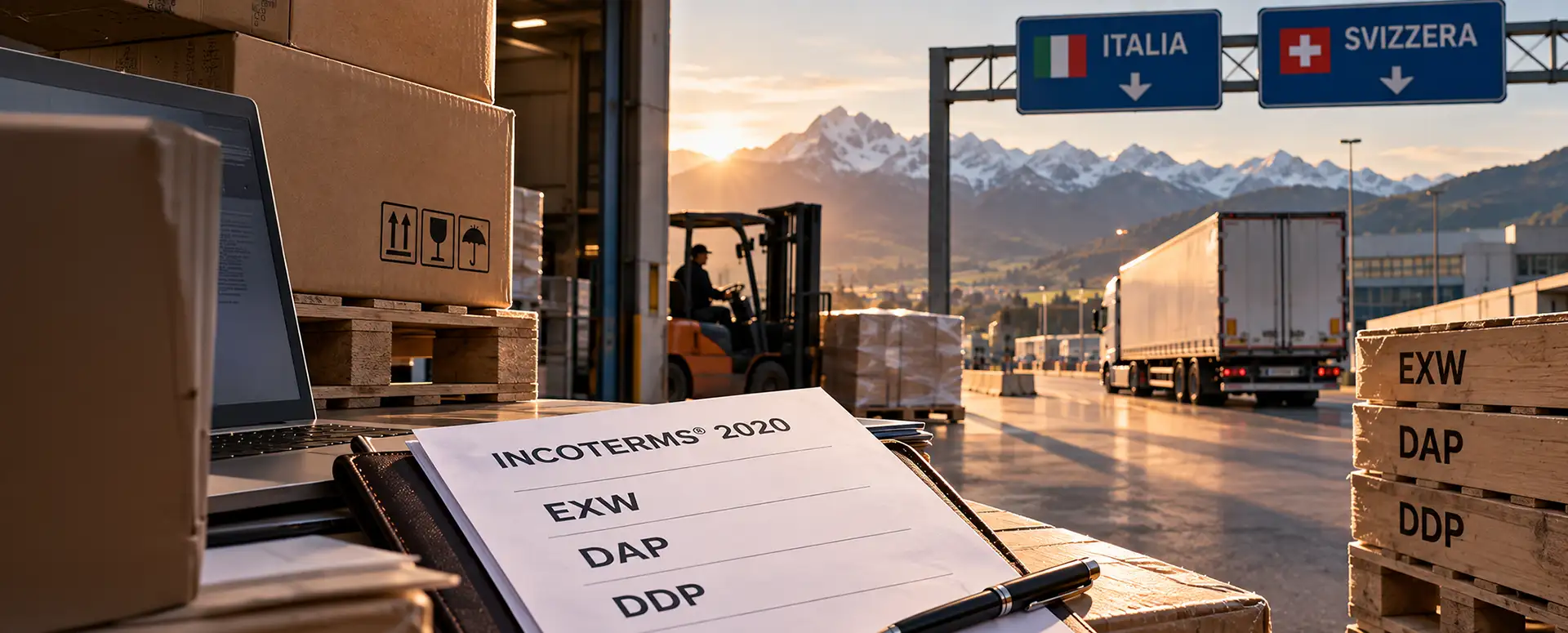
- what EXW, DAP and DDP really mean in this specific context;
- a direct comparison of the three delivery terms;
- how the chosen delivery term affects your work as a freight forwarder.
There Is No Incoterms 2026: What Remains Valid Today
There is no “Incoterms 2026” edition: the edition currently in force is Incoterms® 2020, published by the International Chamber of Commerce (ICC) and effective since 1 January 2020. The ICC updates the Incoterms approximately every ten years and has not yet announced a date for the next revision: anyone writing “Incoterms 2026” in a contract or quotation is referring to something that simply does not exist.
For Italy-Switzerland shipments, this has a practical consequence: every commercial invoice and contract should explicitly refer to “Incoterms 2020”, rather than using a generic year, in order to avoid ambiguity in the event of a dispute with customs authorities or the other party.
Why the Choice of Delivery Term Matters More on the Italy-Switzerland Route
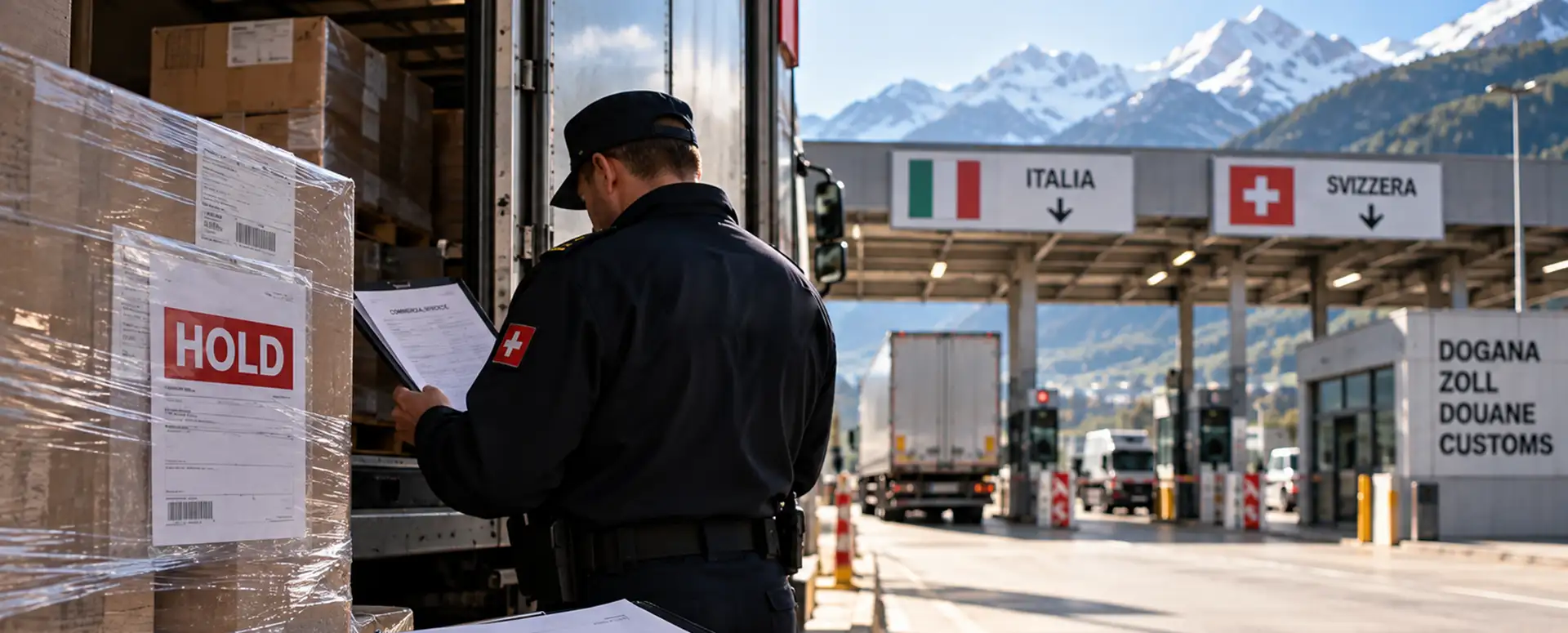
On an intra-EU route, the delivery term mainly affects transport costs and risk, because there is no actual customs border to manage. On the Italy-Switzerland route, the delivery term also determines who is responsible for the export and import customs declarations: if this responsibility is assigned to the wrong party, the shipment may be held at the border regardless of how well the transport itself has been organized.
EXW (Ex Works): What Does It Really Involve?
Under EXW, the seller makes the goods available at its premises and has no further obligations, unless otherwise agreed: the seller is not even required to load the goods onto the means of transport. Everything else — transport, export customs clearance, import customs clearance, duties and VAT — is the responsibility of the Swiss buyer.
The critical point on the Italy-Switzerland route is that in Italy, only a locally established party can normally handle the export customs declaration. With EXW, this obligation would formally fall on the foreign buyer, often creating a practical compliance issue. For this reason, Transuisse recommends in many cases changing the delivery term to FCA or DAP when the Swiss buyer does not have a structured logistics network capable of independently managing collection, transport and customs clearance.
DAP (Delivered at Place): What Does It Really Involve?
Under DAP, the Italian seller organizes the transport and handles export customs clearance, delivering the goods to the agreed location in Switzerland without unloading them from the vehicle, unless otherwise agreed.
The Swiss buyer remains responsible for import customs clearance, duties and VAT upon entry. This is the most common delivery term for Italy-Switzerland shipments when the seller wants to retain control over the transport without also taking on the import-related obligations.
DDP (Delivered Duty Paid): What Does It Really Involve?
Under DDP, the Italian seller assumes every obligation, from export customs clearance through to delivery, with Swiss duties and VAT already paid. For the buyer, this is the most convenient delivery term because they do not have to handle any customs formalities.
For the seller, however, it is also the most demanding option: it requires solid internal customs management or a logistics partner capable of handling it, because any error during the import phase falls directly on the seller.
Direct Comparison: EXW, DAP and DDP on the Italy-Switzerland Route

| EXW | DAP | DDP | |
|---|---|---|---|
Export customs clearance (Italy) |
Swiss buyer |
Italian seller |
Italian seller |
Main transport |
Organized by the buyer |
Organized by the seller |
Organized by the seller |
Import customs clearance (Switzerland) |
Buyer |
Buyer |
Seller |
Import duties and VAT |
Paid by the buyer |
Paid by the buyer |
Paid by the seller |
Transfer of risk |
When the goods leave the seller’s premises |
Upon delivery at the agreed place |
Upon delivery at the agreed place |
How the Choice of Delivery Term Affects Your Work as a Freight Forwarder
If you manage transport on behalf of a Swiss customer who has purchased under EXW terms, you may find yourself having to handle an export declaration that would formally fall to a party without an establishment in Italy. This is something worth clarifying with your logistics partner before departure, not at the time of collection.
The chosen delivery term also affects the quotation you receive: we discuss this in “How Much Does an Italy-Switzerland Shipment Cost? The Variables That Really Determine the Price”.
With DAP or DDP, customs responsibility is already defined from the outset, and your role focuses on verifying that the seller’s chosen partner actually manages customs internally, through a single point of contact, rather than outsourcing it to different parties along the route.
Transuisse, Your Partner for Managing Italy-Switzerland Delivery Terms
Since 1997, Transuisse has supported freight forwarders and companies in choosing and managing the most suitable delivery term for each Italy-Switzerland shipment, handling export customs clearance internally and, where required by the delivery term, import customs clearance in Switzerland.
We are a family-run company, with direct responsibility for every stage we coordinate.
We operate as an Authorized Economic Operator (AEO) No. 14 0937, a certification confirming compliance with specific requirements concerning reliability and customs compliance.
Frequently Asked Questions About DDP, DAP and EXW for Italy-Switzerland Shipments
No. As of July 2026, the edition currently in force remains Incoterms® 2020. The ICC updates the Incoterms approximately every ten years and has not yet announced a date for the next revision.
There is no universally safest delivery term: it depends on which party has the logistics structure required to manage customs and transport.
DAP and DDP reduce the compliance burden for the Swiss buyer compared with EXW because they keep responsibility for export customs clearance with the Italian seller, which is established in the country of departure.
Formally, the buyer. In practice, however, this often creates a compliance issue because in Italy an export declaration normally requires a party established locally.
For this reason, many companies prefer to change the delivery term to FCA or DAP when the Swiss buyer does not have a structured logistics network.
No. DDP is appropriate when the seller has, or relies on a partner with, solid internal customs management. In this case, it provides a more convenient service for the buyer and greater control over the entire shipment.
Without this structure, DDP exposes the seller to the risk of errors during the import phase which, under DAP, would remain the buyer’s responsibility.
The Delivery Term Should Be Chosen Before the Shipment, Not Discovered During Transport
Every delivery term clarified in advance means one less ambiguity to resolve with the customer halfway through the journey.
Would you like to learn more about what to do when, despite everything, a shipment remains held by customs?
“Italy-Switzerland Customs Clearance: Actual Timeframes and Critical Variables”
If you would like to assess with us which delivery term best suits your Italy-Switzerland flow, we can discuss your specific case.
Discover the Transuisse customs management service or contact us for an introductory call.