i>Guide prepared by the Transuisse Editorial Team. Since 1997, we have been supporting freight forwarders and companies in managing shipments between Italy and Switzerland, handling transport, cargo consolidation and customs procedures on a daily basis along the cross-border route. Transuisse is an Authorized Economic Operator (AEO) No. 14 0937.
There is no fixed customs clearance time for an Italy-Switzerland shipment. The actual time depends on specific and verifiable variables, not simply on the distance travelled: two shipments following the same route can have very different customs clearance times depending on how they were prepared.
If you need to provide your customer with a delivery timeframe, knowing which variables actually affect customs clearance time allows you to provide a realistic estimate rather than a generic figure that may later be contradicted by actual events.
In this guide, we will look at:
- which variables actually determine the customs clearance time of an Italy-Switzerland shipment;
- why the same route can require very different times from one shipment to another;
- how much the time of day at which the border is crossed affects the overall timing;
- how customs clearance times differ between groupage and full loads;
- how to set realistic expectations with your customers.
Why There Is No Fixed Customs Clearance Time for Italy-Switzerland Shipments
The customs clearance time of an Italy-Switzerland shipment is the sum of several distinct stages: customs declaration, any documentary inspection, any physical inspection and assessment decision. It is not simply a single procedure at the border.
Each of these stages can take a few minutes or several hours, depending on how the shipment was prepared before even reaching the Chiasso border crossing.
Anyone who communicates a fixed customs clearance time that is the same for every shipment is communicating an average, not a reliable figure. The useful question is not “how long does customs clearance take?”, but rather “which variables, in this specific case, may increase or reduce the expected time?”
The Variables That Actually Determine Customs Clearance Time
1. Completeness and Consistency of the Documentation
Complete and consistent documentation from the outset is the variable that has the greatest impact on customs clearance time. The commercial invoice, transport document and customs declaration must match in every detail: even a single minor inconsistency can trigger a request for clarification that extends the clearance time regardless of all other variables.
2. Type of Inspection: Documentary or Physical
A documentary inspection, which only checks the consistency of the paperwork, generally takes a few minutes if the documentation is in order.
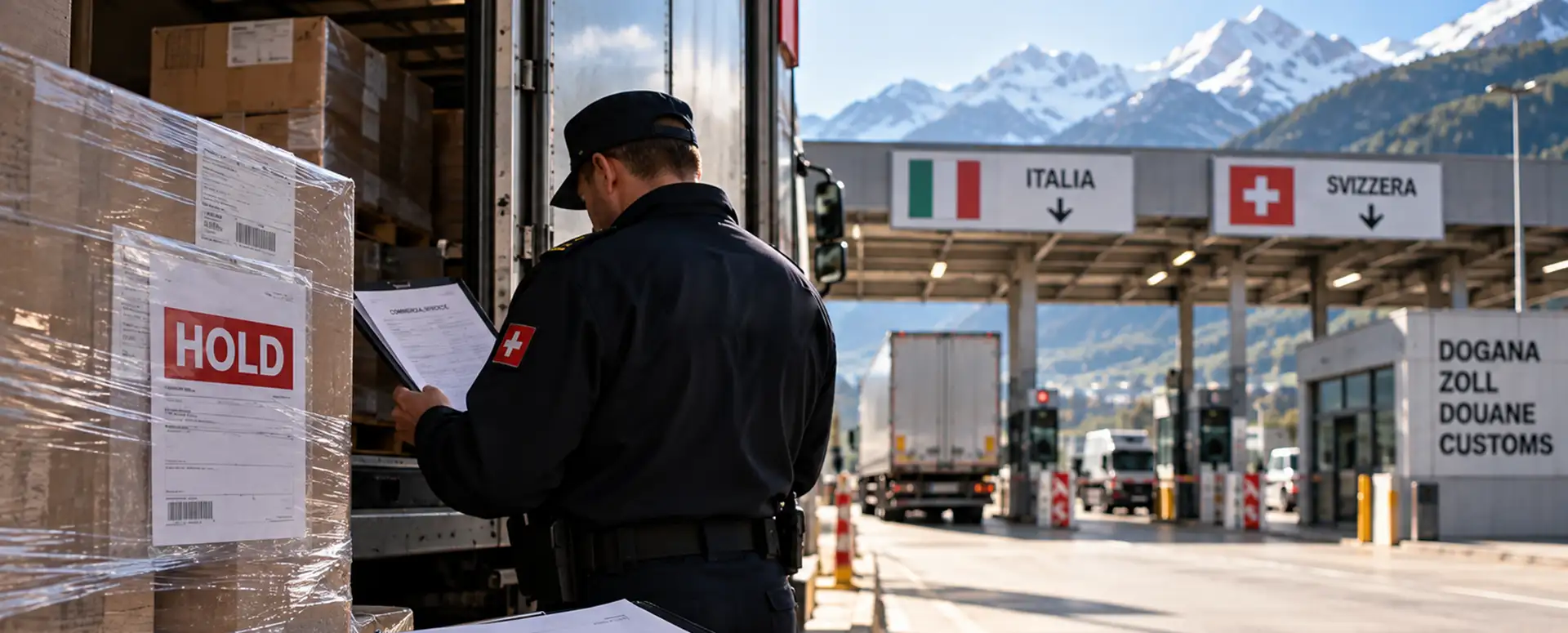
A physical inspection, which involves opening the vehicle and checking the goods, takes considerably longer and cannot always be predicted in advance. Swiss customs orders such inspections based on the risk profile of the shipment, rather than according to a schedule known in advance.
3. Type of Goods and Customs Code
Certain categories of goods require additional checks that can extend customs clearance times regardless of the quality of the documentation: food products, restricted substances and machinery requiring specific technical certifications.
Even a correct customs code relating to a sensitive category may result in a more thorough inspection than one involving standard goods.
4. Time of Day and Day of the Week When Crossing the Border
Congestion at the border affects the overall transit time, even when the customs procedure itself is already ready.
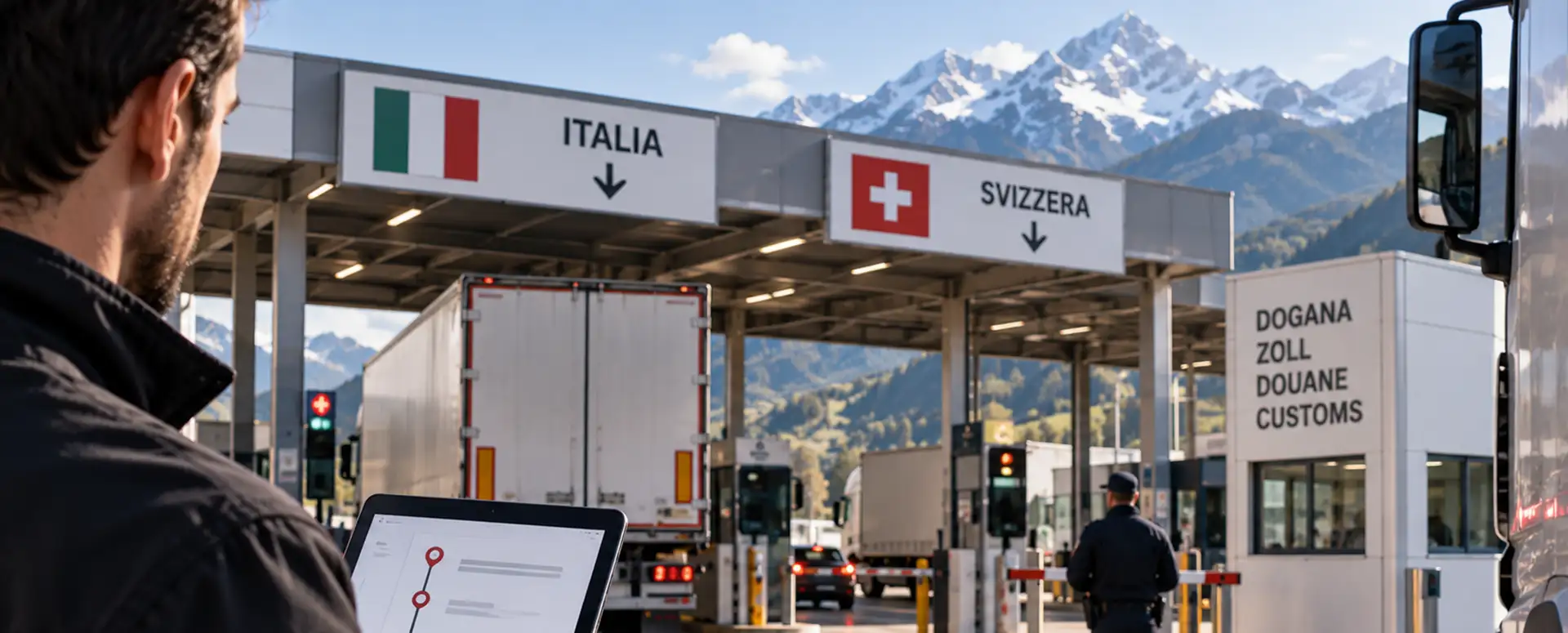
Cross-border traffic at Chiasso-Brogeda experiences heavier queues during the morning and late-afternoon peak periods, with waiting times generally decreasing during mid-morning and mid-afternoon. More pronounced peaks may occur around public holidays or local events that alter normal traffic patterns.
Whenever possible, planning the vehicle’s departure outside these peak periods can reduce the overall transit time even when the documentation is identical.
5. Groupage or Full Load
A groupage shipment involves an additional stage that a full load does not: consolidation at the warehouse before departure.
This means that the overall time from collection to delivery is naturally longer for a groupage shipment, regardless of how quickly customs clearance itself is completed. We discuss this in more detail later in this guide.
6. Exporter's Authorized Economic Operator (AEO) Status
Authorized Economic Operator (AEO) status, mutually recognised between the European Union and Switzerland, confirms compliance with specific reliability and customs compliance requirements and can result in more streamlined checks at the border.
It does not guarantee exemption from every inspection, but it reduces the risk profile with which Swiss customs handles shipments from a certified operator.
7. The Transition from e-dec to the New Passar System
From 2026, export declarations must be submitted through Passar Export, e-dec Web or via a customs clearance service provider, as derogations for prolonged use of e-dec Export are no longer accepted.
During the transition between the two systems, an operator that has not yet adapted its procedures risks delays in the transmission of customs declarations, regardless of the quality of the documentation.
How Much Does the Time of Day at the Border Affect the Overall Timing?
Congestion at the Chiasso border generally follows a predictable pattern on most working days: the early-morning and late-afternoon peak periods experience the longest waiting times, while traffic tends to decrease significantly during mid-morning and mid-afternoon.
Specific events—for example, the first Monday of the month, the days before Italian or Swiss public holidays, or roadworks in customs areas—can double waiting times compared with an ordinary day.
This variable does not depend on the quality of the documentation, but it still affects the overall timeframe communicated to the customer. Planning the vehicle’s departure with expected congestion in mind reduces the risk of a delay that might otherwise appear to be a customs problem when it is actually a traffic issue.
Groupage or Full Load: Why the Times Differ
The overall transit time of a groupage shipment should be calculated in days rather than hours because of the consolidation and customs stages. This is useful information to communicate to customers in advance, before it becomes an issue to manage while the delivery is already in progress.
A full load, which does not require consolidation, may have a shorter overall transit time for the same customs clearance conditions, but it does not offer the cost optimisation that groupage provides for smaller volumes.
The variables affecting the price of a shipment, including time, are described in detail in “How Much Does an Italy-Switzerland Shipment Cost? The Variables That Really Determine the Price”.
The choice between the two options depends on the volume and urgency of the shipment, not on which one is generally faster. A well-organised groupage service, with regular departures and planned consolidation, can have more predictable transit times than a full load managed without equally solid planning.
How to Set Realistic Expectations with Your Customers
Communicating a time range rather than a single figure at the quotation stage allows you to manage customer expectations without having to revise them later.
A few questions can help you build a realistic estimate:
- Is the documentation for this shipment already complete and consistent, or does it still need to be checked?
- Does the goods category require additional inspections?
- Is the vehicle scheduled to depart during a peak period or outside it?
- Is this a groupage shipment or a full load?
- Has the partner handling customs already adapted its procedures to the Passar system?
Transuisse, Your Partner for Italy-Switzerland Customs Clearance
Since 1997, Transuisse has managed the customs clearance of Italy-Switzerland shipments internally, from the preliminary verification of documentation to planning departures according to expected border traffic.
We are a family-run company with direct responsibility for every stage we coordinate.
We operate as an Authorized Economic Operator (AEO) No. 14 0937, a certification confirming compliance with specific reliability and customs compliance requirements, and we monitor developments in Swiss customs regulations, including the transition to the new Passar system.
Our departures follow a regular schedule from our warehouse in Turate, a short distance from the Swiss border, allowing us to provide realistic timeframes from the quotation stage.
If you would like to learn more about how to keep track of a shipment that has already departed, also read: “How to Keep Track of an Italy-Switzerland Shipment: Timing, Tracking and Updates”.
Frequently Asked Questions About Italy-Switzerland Customs Clearance Times
There is no single timeframe. It depends on the completeness of the documentation, the type of inspection (documentary or physical), the category of goods, the time of day when the border is crossed and the transport method (groupage or full load).
With documentation in order and outside peak periods, customs clearance generally takes a few hours. A physical inspection or documentary anomaly can extend this to several days.
Customs Clearance Time Should Be Communicated in Advance, Not Discovered at the Border
Every variable checked before departure is one less uncertainty to manage with your customer.
Would you like to learn more about the mistakes that can turn an expected timeframe into an actual customs hold?
Read also: “Italy-Switzerland Customs: The 7 Mistakes That Slow Down Shipments (and How to Avoid Them)”, “DDP, DAP, EXW: What Really Changes for Italy-Switzerland Shipments”.
If you would like to assess with us how realistic the timeframes currently communicated for your Italy-Switzerland flow are, we can discuss your specific case together.
Discover the Transuisse customs management service or contact us for an introductory call.