Guide prepared by the Transuisse Editorial Team. Since 1997, we have been supporting freight forwarders and companies in managing shipments between Italy and Switzerland, handling transport, cargo consolidation and customs procedures on a daily basis along the cross-border route. Transuisse is an Authorized Economic Operator (AEO) No. 14 0937.
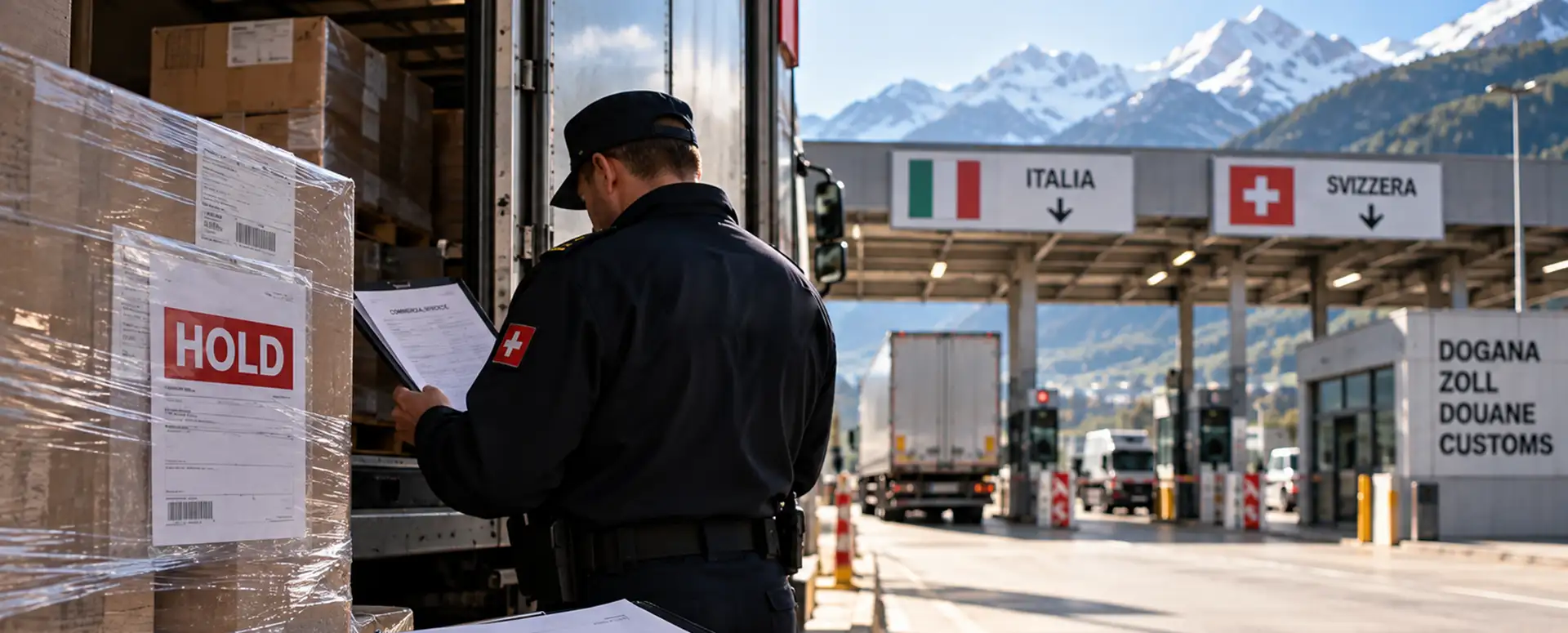
A single missing document among those essential for exporting to Switzerland can hold up an entire shipment at the border, regardless of how well organised the rest of the process is.
For a freight forwarder managing shipments to Switzerland on behalf of its customers, knowing which documents are truly essential, rather than merely recommended, is what makes it possible to identify an anomaly before the vehicle departs instead of discovering it at customs.
In this guide, we will look at:
- which documents are essential for exporting to Switzerland without customs holds;
- what happens when one of these documents is missing or incorrectly completed;
- how documentation changes depending on the value and type of goods;
- how Swiss customs declarations are changing with the transition to the Passar system;
- how to verify that the documentation is complete before departure.
Why Documentation for Switzerland Requires More Attention Than Within the EU
Exporting to Switzerland requires customs documentation that is not necessary for intra-EU transport, because Switzerland is a non-EU country for customs purposes. Every shipment must be declared for export in Italy and subsequently imported into Switzerland, involving an actual customs procedure at the border.
The Chiasso border crossing, the main crossing point on the Italy-Switzerland route, is one of the busiest in Europe in terms of the volume of commercial vehicles and goods. With such high volumes, Swiss customs has little room for incomplete documentation: if the verification is not passed, the result is an administrative hold on the shipment.
The Essential Documents for Exporting to Switzerland Without Customs Holds
Six documents, in particular, are required for every shipment to Switzerland or in most practical cases. Their absence, or an error within them, is one of the most common causes of customs holds at the border.
1. Commercial Invoice for Switzerland
2. Transport Document (CMR/Delivery Note)
3. Export Customs Declaration
4. Preferential Origin Proof (EUR.1)
The EUR.1 document certifies the preferential origin of the goods and allows the Swiss consignee to benefit from a full or partial exemption from import duties under the preferential agreements between the EU and Switzerland.
It must be requested and validated by the export customs office before the goods depart. An EUR.1 that has not been validated in time cannot be corrected once the vehicle has left the sender’s premises.
5. Transit Document (T1/T2), When Goods Cross Third Countries
The transit document is only essential in specific cases and is not required for every shipment. It is needed when the goods have not yet been customs cleared and must cross the customs territory of the European Union before reaching Switzerland (T1), or when goods already in free circulation in the EU must cross Swiss territory to reach another destination (T2).
For a shipment travelling directly from Italy to Switzerland with its final destination in Switzerland, it is generally not required. It becomes particularly relevant in triangular transactions or transit operations involving third countries.
6. Specific Documentation for Goods Subject to Restrictions or Special Customs Procedures
Certain categories of goods require additional documents in addition to the essential ones: health or phytosanitary permits for food and agricultural products, technical certifications for machinery, or an ATA Carnet when goods are intended for trade fairs, events, repairs or temporary professional activities in Switzerland and are subsequently expected to return to Italy without payment of duties and taxes.
In these specific cases, the question is not simply which document is generally required, but whether your logistics partner already knows which documentation must be requested before departure for that specific category of goods or type of operation.
What Changes Depending on the Value and Type of Goods
The value of the goods directly affects which proof of origin is required. For a value below EUR 6,000, preferential origin may be proven by a simple invoice declaration instead of requiring a separate EUR.1.
Above this threshold, the EUR.1 remains the reference document and must be validated before departure.
The type of goods also affects the documentation required. A standard product may involve a relatively straightforward documentation process, whereas food products, machinery subject to technical certification or goods intended for a temporary exhibition may require an additional specific document.
Checking the product category before preparing the documentation avoids discovering, after collection has already taken place, that a required authorisation is missing.
What Changes with the Transition from e-dec to Passar in 2026
From 2026, the FOCBS no longer accepts requests for derogations allowing prolonged use of e-dec Export. Export declarations must be submitted through Passar Export, e-dec Web or via a customs clearance service provider.
The new Passar system is progressively replacing e-dec, initially for transit and export, with the stated aim of standardising customs processes and reducing administrative costs.
If you entrust the documentation to an Italian partner, this has one concrete implication: verify that your contact has already adapted its internal procedures to the new system rather than continuing to operate on a platform that is being phased out.
A delay in adapting procedures can, in practice, create a risk of interruptions in the transmission of the declaration precisely when they are least expected.
How to Check That the Documentation Is Complete Before Departure
A few questions can help determine, before the vehicle leaves the sender’s premises, whether the documentation is actually complete.
- Does the commercial invoice contain all mandatory information, including a sufficiently detailed description of the goods?
- Does the transport document (CMR/delivery note) correspond in every respect to the commercial invoice?
- Based on the shipment value, is a separate EUR.1 required or is an invoice declaration sufficient?
- Does the goods category require an additional authorisation or certification?
- Who checked these points, and when: before departure or only after a problem occurred?
Transuisse, Your Partner for Italy-Switzerland Customs Documentation
Since 1997, Transuisse has internally verified every document required for exports to Switzerland, from the commercial invoice to the customs declaration, before the vehicle reaches the border. We are a family-run company with direct responsibility for every stage we coordinate.
We monitor developments in Swiss customs regulations, including the transition to the new Passar system, and verify for every shipment whether an EUR.1, a transit document or a specific authorisation is required, based on the value and category of the goods.
We operate as an Authorized Economic Operator (AEO) No. 14 0937, a certification confirming compliance with specific reliability and customs compliance requirements.
This is also one of the reasons why, when evaluating a partner for the Italy-Switzerland route, it is worth understanding whether customs is managed internally or outsourced to a third party: we discuss this in
“Direct Carrier or Freight Forwarder? What Really Changes on the Italy-Switzerland Route.”
Frequently Asked Questions About Documents for Exporting to Switzerland
The commercial invoice, transport document (CMR/delivery note) and export customs declaration are essential for every shipment.
Depending on the circumstances, these are supplemented by the EUR.1 document for preferential origin, a transit document (T1/T2) and, for certain categories of goods, specific authorisations or certifications.
Without an EUR.1 validated in time, the Swiss consignee loses the right to the duty exemption or reduction provided for under the preferential agreements between the EU and Switzerland, and the goods are cleared under the standard customs regime.
For a value below EUR 6,000, an invoice declaration may replace the EUR.1.
Correct Documentation Is Prepared Before Departure, Not at the Border
Every document checked before departure is a customs hold that your customer will never have to experience.
Would you like to learn more about the most common errors that can lead to a customs hold?
Read also: Italy-Switzerland Customs: The 7 Mistakes That Slow Down Shipments (and How to Avoid Them), or: Italy-Switzerland Customs Clearance: Real Times and Critical Variables.
If you would like to check with us whether the documentation for your Italy-Switzerland flow is actually complete, we can analyse it together before your next shipment.
Discover the Transuisse customs management service or contact us for an introductory call.