Guide prepared by the Transuisse Editorial Team. Since 1997, we have been supporting freight forwarders and companies in managing shipments between Italy and Switzerland, handling transport, freight consolidation and customs procedures on a daily basis along the cross-border route. Transuisse is an Authorised Economic Operator (AEO) No. 14 0937.
For an occasional shipper, making a mistake on a shipment to Switzerland will, in most cases, result in nothing more than a delay.
For a freight forwarder, the same mistake has a different impact: it affects a customer who expected a reliable service and who will hardly distinguish between a transport problem and a problem with your service.
The mistakes that really matter on the Italy-Switzerland route are not the occasional errors made by someone shipping once in a while. They are recurring organisational issues that, over time, wear down the trust you have built with your customers.
In this guide, we will look at:
- why mistakes on this route have a greater impact than on other European routes;
- the most common operational issues when managing Italy-Switzerland groupage;
- why these issues often depend on the partner’s organisation rather than on the individual transport;
- how to identify in advance a partner who may cause them.
Why mistakes on the Italy-Switzerland route have a greater impact than elsewhere
Transport within the European Union can tolerate, within certain limits, some organisational inaccuracies: there is no actual customs border to cross, and a delay of a few hours rarely compromises the entire shipment.
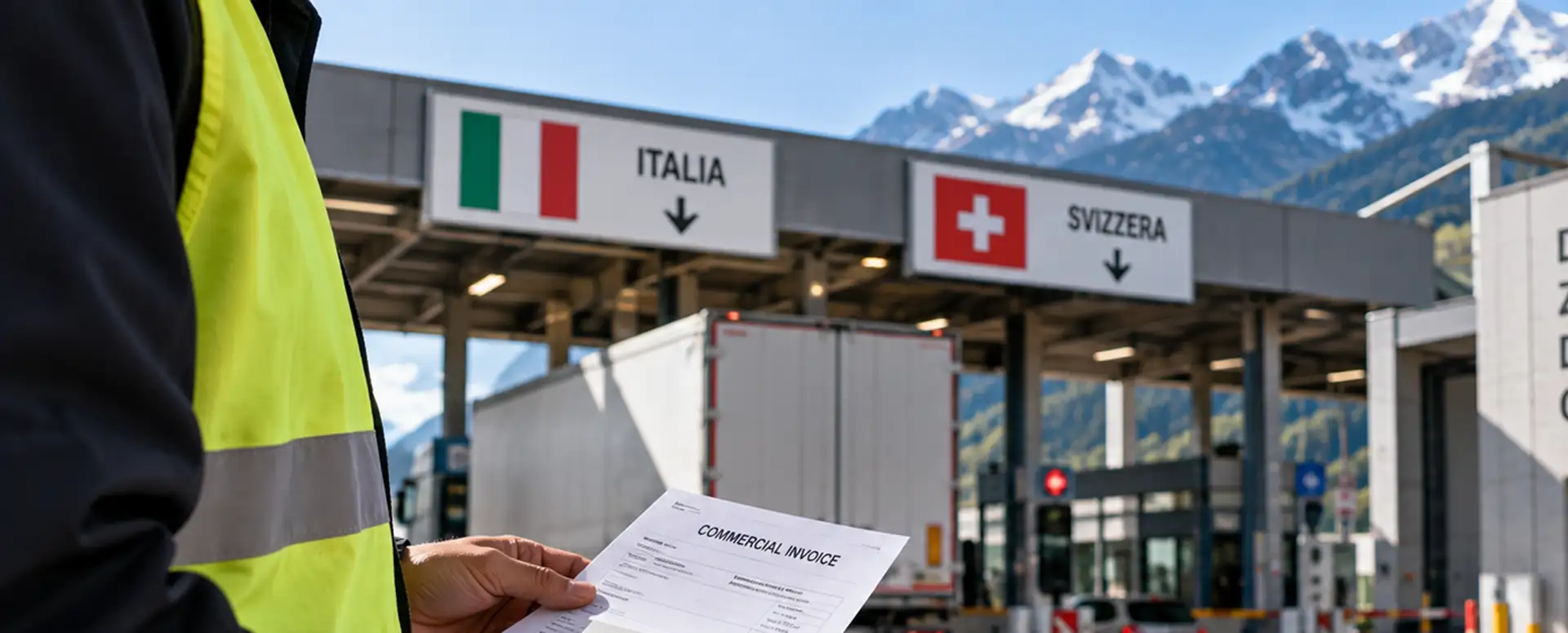
On the Italy-Switzerland route, this margin is smaller. Every shipment crosses an actual customs border, and in a groupage load a single documentation error can hold up the entire vehicle, not just the shipment concerned.
For this reason, an error that would be marginal elsewhere can become a problem affecting all customers whose goods are on that load.
The most common mistakes when managing the route
After years of working on this route, we have identified a number of recurring issues. They almost never concern the transport itself, but rather the way it is organised before and during the journey.
1. Uncoordinated collections
When collections from different shippers in Italy are not planned accurately, the consolidation flow is affected. Goods arriving at the warehouse too late may miss the scheduled departure, creating a knock-on effect across the entire weekly planning.
For you, this translates into delivery times becoming unpredictable precisely when your customer expects the opposite.
2. Incomplete or approximate documentation
A non-compliant invoice, a generic description of the goods or missing information on the customs declaration: in standard European transport, these errors would probably be absorbed without major consequences. For shipments to Switzerland, however, they can stop customs clearance of the entire load.
The problem is rarely the individual incorrect document. The problem is that nobody checked it before departure.
3. Information fragmented between too many parties
When transport, consolidation and customs are managed by different parties, every request for an update has to pass from one contact to another. The result is information that arrives late, often incomplete and sometimes contradictory.
For the freight forwarder, this means one thing: not being able to answer immediately when the customer calls to ask where their goods are.
4. Irregular departures
A groupage flow works when departures are predictable. If they depend on reaching a minimum load level, without a defined schedule, every shipment becomes uncertain: sometimes it leaves immediately, while at other times it remains waiting without a clearly communicated reason.
This unpredictability is difficult to manage with a customer who, quite reasonably, expects consistent timings.
5. Failure to handle issues proactively
A customs issue, a document that needs to be supplemented or missing information: if these situations are identified before the vehicle departs, they can usually be resolved without any real impact on delivery times.
When they only emerge at the customs border, however, the delay affects the entire load, and at that point there is no longer much room to intervene without consequences.
Why these mistakes depend on organisation, not on the individual transport
None of these mistakes is usually the result of isolated negligence. They arise from an organisation that treats transport, consolidation and customs as separate activities managed by different parties whose information does not flow properly between them.
When a single organisation handles the entire process, from collection to final delivery, every stage becomes visible and issues can be identified before they become a problem for the final customer.
The choice between using your own vehicles and subcontracting also has an impact here: every handover to a third-party carrier creates another point at which information can be lost or delayed. A partner with its own fleet, using external providers only when necessary, has direct visibility of the shipment that a pure intermediary cannot have.
Even when a mistake causes actual damage to the goods, the difference between standard carrier liability insurance and all-risk coverage determines how quickly the situation can be resolved with the final customer, and how much risk you, as a freight forwarder, remain exposed to.
For more information on the impact of document management on this route, it is also worth reading:
How to identify in advance a partner who may cause these mistakes
Before these mistakes occur, certain signals can help you assess the situation in advance.
- Who coordinates collections from the shippers, and how far in advance?
- Is the documentation checked before departure or only when problems arise?
- How many different people are involved between collection and final delivery?
- Do departures follow a defined schedule or depend on the vehicle being filled?
- Is there a process to identify an issue before the vehicle reaches the border?
A partner who answers these questions clearly before you even need to ask them after a problem has occurred is generally a partner who has already dealt with these issues and built a process to prevent them.
Want to learn more?
Transuisse, your partner for Italy-Switzerland shipments
Since 1997, we have managed collection, consolidation, customs procedures and final distribution internally on the Italy-Switzerland route, from our own warehouse in Turate, just a short distance from the border. We are a family-run company: the organisation that decides how to structure a flow is the same one responsible for it.
This means a single organisation oversees the entire shipment, with our own vehicles used for most transports rather than a series of handovers between different parties. Documentation issues are checked before departure, not discovered at customs, and departures follow a regular schedule that allows realistic transit times to be communicated from the quotation stage. Every shipment travels with carrier liability insurance, with the possibility of all-risk coverage upon request.
We operate as an Authorised Economic Operator (AEO) No. 14 0937, a certification confirming compliance with specific requirements regarding customs reliability and compliance.
Frequently asked questions about mistakes in Italy-Switzerland shipments
Because in a consolidated vehicle, all shipments share the same customs clearance process. An issue with a single shipment can hold up customs clearance for the entire load, not just the shipment concerned.
Uncoordinated collections, incomplete documentation, fragmented information between several parties, irregular departures and failure to address customs issues proactively.
By entrusting the entire flow, from collection to delivery, to a single organisation that manages transport, consolidation and customs internally, reducing the number of handovers between different parties.
A single isolated incident, clearly communicated and handled in time, rarely undermines a solid relationship. It is the repetition of similar organisational issues over time that erodes trust.
Fewer problems to manage, more time for your customers
Every mistake prevented before departure is a problem your customer will never see.
If you would like to assess with us where the current critical points in your Italy-Switzerland flow are concentrated, we can analyse it together and identify where action is needed.
Discover our dedicated service for Italy-Switzerland freight forwarders or contact us for an introductory call.