Guide prepared by the Transuisse Editorial Team. Since 1997, we have been supporting freight forwarders and companies in managing shipments between Italy and Switzerland, handling transport, cargo consolidation and customs procedures on a daily basis along the cross-border route. Transuisse is an Authorized Economic Operator (AEO) No. 14 0937.
A customs error does not simply delay a shipment. In a consolidated load, a single non-compliant document can hold up all shipments carried on the same vehicle.
The errors that cause shipments to be stopped at Italy-Switzerland customs are rarely unpredictable. They are recurring documentation and organisational issues that can be identified and avoided before the goods reach the border.
In this guide, we will look at:
- the 7 most common mistakes in customs management on the Italy-Switzerland route;
- why each of these mistakes causes a shipment to be stopped, rather than simply delayed;
- what is changing in 2026 in the Swiss customs declaration systems;
- how to identify a partner capable of reducing these risks.
Why a Customs Error Has a Greater Impact Than a Transport Error
A customs error can stop the entire customs clearance procedure, not just the individual shipment concerned. On the Italy-Switzerland route, every shipment crosses an actual customs border into a non-EU country. Unlike transport within the European Union, there is no room here for documentary inaccuracies that might be absorbed without consequences elsewhere.
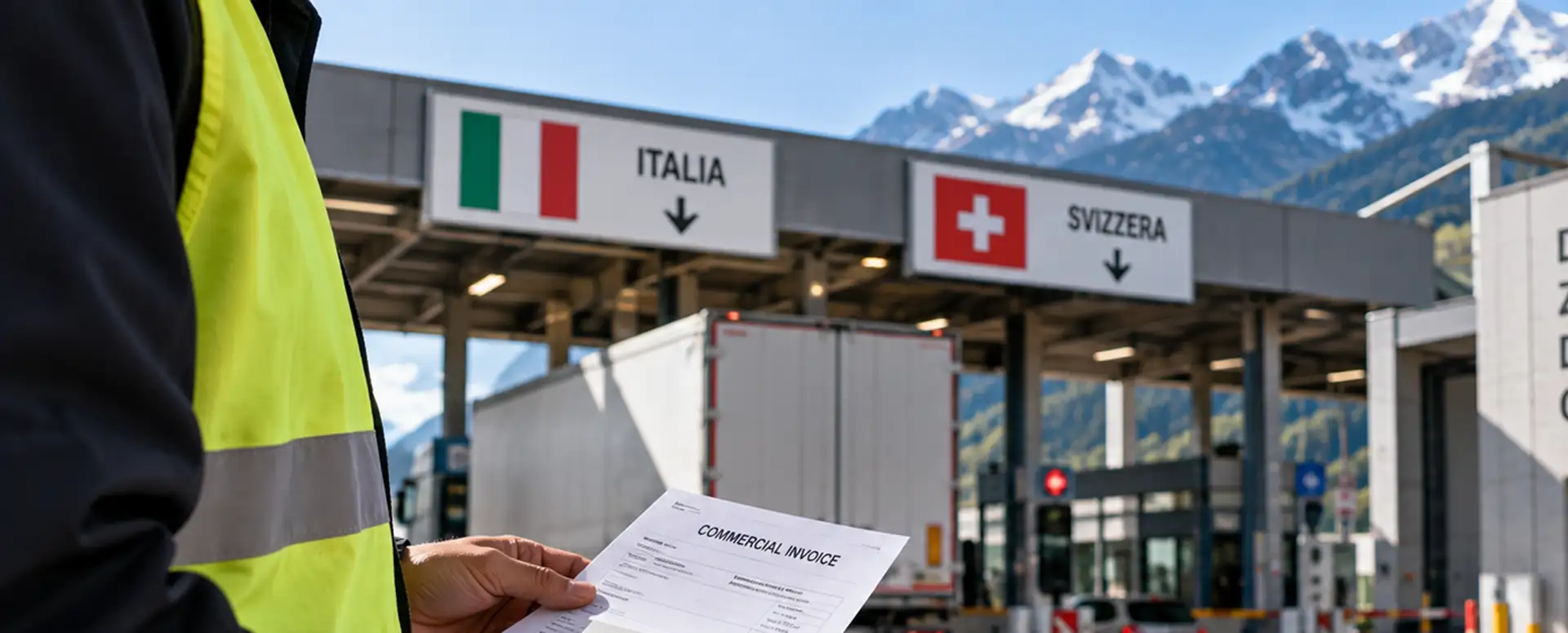
The Chiasso border crossing, the main crossing point on the Italy-Switzerland route, is one of Europe’s busiest in terms of the volume of commercial vehicles and goods. In a context involving such high volumes, a documentary anomaly that has not been resolved before the vehicle departs will almost always result in an administrative hold rather than a simple delay.
The 7 Mistakes That Slow Down Shipments at Italy-Switzerland Customs
After years of directly managing customs procedures on the Italy-Switzerland route, these are the mistakes we see recurring most frequently.
1. Incomplete or Non-Compliant Commercial Invoice
A commercial invoice missing even a single mandatory piece of information can stop customs clearance for the entire shipment. The commercial invoice for Switzerland must contain complete exporter and consignee details, a detailed description of the goods, the declared value, the applicable Incoterm, the country of origin of the goods and the sender’s signature. Missing information or an overly generic description of the goods is the most frequent cause of objections by Swiss customs.
2. Incorrect or Generic Customs Tariff Code
An incorrect or overly generic customs code can trigger a physical inspection which, on the Italy-Switzerland route, may stop the entire consolidated vehicle. Each customs tariff heading determines not only the amount of import duties applied, but also the level of attention with which Swiss customs handles the shipment. An inaccurate code, selected approximately rather than verified against the official customs tariff (Tares), increases the risk of documentary or physical inspection at the border.
3. Missing or Untimely Validation of Preferential Origin Proof (EUR.1)
Without the EUR.1 document, or without its validation by the export customs office before the goods depart, the Swiss consignee loses the right to the exemption or reduction of duties provided for under the preferential agreements between the EU and Switzerland. For goods valued at less than EUR 6,000, proof of origin may be replaced by an invoice declaration, but only if it is correctly prepared: an EUR.1 requested too late, or never validated, is an error that is almost always discovered too late to be corrected without affecting transit times.
4. Transport Document (CMR/Delivery Note) Inconsistent with the Commercial Invoice
When the information on the international transport document (CMR) does not correspond to the commercial invoice (quantity, weight, description of goods), Swiss customs considers the file non-compliant, regardless of which of the two documents contains the error. The CMR physically accompanies the goods and constitutes the international road transport contract: discrepancies between the CMR and the invoice are among the most common anomalies identified during checks at the Chiasso border crossing.
5. Customs Declaration Prepared at the Last Minute Without Prior Verification
An export customs declaration completed only when the vehicle is about to depart leaves no room to correct an error before it becomes a hold. Documentary anomalies identified in the days before departure can almost always be resolved without affecting delivery times; the same anomalies discovered at customs translate into a hold involving the entire consolidated load, not just the shipment concerned.
6. Transition from the e-dec System to the New Passar System Managed Without Preparation
From 2026, the Swiss Federal Office for Customs and Border Security (FOCBS) no longer accepts requests for derogations allowing prolonged use of e-dec Export. The options now available for export declarations are Passar Export, e-dec Web, or appointing a customs clearance service provider. The new Passar system is progressively replacing e-dec for transit and export, with the aim of harmonising customs processes. Companies that continue operating as if nothing had changed risk interruptions in the transmission of declarations precisely during the transition phase.
7. No Single Point of Contact to Intervene in the Event of an Anomaly
When transport, customs and consolidation are handled by different parties, a customs anomaly takes time just to reconstruct before it can even be resolved. For you, who have to respond to the customer, the absence of a contact person responsible for the shipment as a whole can turn a manageable documentary issue into a delay affecting the entire flow.
Why These Errors Depend on Customs Organisation, Not on the Individual Shipment
None of these errors normally results from isolated negligence. They arise from an organisation that treats customs management as an outsourced activity separate from transport, rather than as an integrated part of the same process. When a single structure manages both transport and customs internally, every stage is visible and anomalies can be identified before the vehicle departs.
Authorized Economic Operator (AEO) status also plays a role here. This is a certification mutually recognised between the European Union and Switzerland since 2009 under the agreement on customs facilitation and security. It confirms compliance with specific reliability and customs compliance requirements and can result in more streamlined checks at the border.
This article focuses on errors specifically related to customs procedures. If the issue you are experiencing instead concerns the operational phase upstream—uncoordinated collections, irregular departures or fragmented information between too many contacts—you can find useful information in the article “Italy-Switzerland Shipments: The Most Common Mistakes Made When Managing the Route”.
How to Identify a Partner Who Can Reduce These Risks
A few questions can help you assess, before entrusting a partner with a regular flow, how well organised they are to prevent these errors.
- Who checks the commercial invoice and transport document before the vehicle departs?
- Who verifies the customs code of the goods, and against which source (official customs tariff)?
- Who handles the request and validation of the EUR.1 document when required?
- Is the customs declaration prepared in advance or only when the vehicle departs?
- Has the partner already adapted its procedures to the new Passar system?
- Is there a single contact person who can be reached in the event of a customs anomaly?
Transuisse, Your Partner for Italy-Switzerland Customs
Since 1997, Transuisse has managed the customs procedures for Italy-Switzerland shipments internally, from the preliminary verification of the commercial invoice and transport document through to the export customs declaration. We are a family-run company with direct responsibility for every stage we coordinate.
We do not simply prepare a declaration: we verify the customs code, preferential origin proof and documentary consistency before the vehicle reaches the border, and we monitor developments in Swiss customs regulations, including the transition to the new Passar system. Each shipment is handled by a dedicated contact who knows the entire file, not just its status in a system.
We operate as an Authorized Economic Operator (AEO) No. 14 0937, a certification confirming compliance with specific reliability and customs compliance requirements. For a complete overview of the documents required for exports to Switzerland, our reference guide is:
Frequently Asked Questions About Italy-Switzerland Customs Errors
If a document is missing, Swiss customs may stop the customs clearance of the entire shipment until the missing document is provided, resulting in an administrative hold and additional storage costs. In a consolidated load, the hold affects the entire vehicle, not only the shipment with the missing document.
The most common errors in Italy-Switzerland customs clearance are: incomplete commercial invoices, incorrect customs codes, missing or unvalidated preferential origin proof (EUR.1), inconsistencies between the CMR and the invoice, customs declarations prepared without prior verification, procedures that have not been updated to the Passar system, and the absence of a single contact person in the event of an anomaly.
The Passar system is progressively replacing e-dec for transit and export. From 2026, derogations for prolonged use of e-dec Export are no longer accepted. The available options are Passar Export, e-dec Web, or appointing a customs clearance service provider.
Yes, a partner with in-house customs management can reduce the risk of shipments being stopped by making it possible to verify the invoice, customs code and proof of origin before the vehicle departs, rather than discovering an anomaly at customs. A structure that outsources customs to a third party adds an information exchange step that can lengthen the time required to correct an issue.
Fewer Customs Errors, Less Time Spent Chasing Information
Every error identified before departure is a customs hold that your customer will never have to experience.
Would you like to learn more about which documents are required to avoid specific issues when exporting to Switzerland?
If you would like to assess together with us where the customs risks in your Italy-Switzerland flow currently lie, we can analyse it together and identify where action is needed.
Discover the Transuisse customs management service or contact us for an introductory call.